
Buying Guides
How Hot Rolled Steel is Manufactured: The Journey from Raw Steel to Industrial Strength
28 Aug 2026
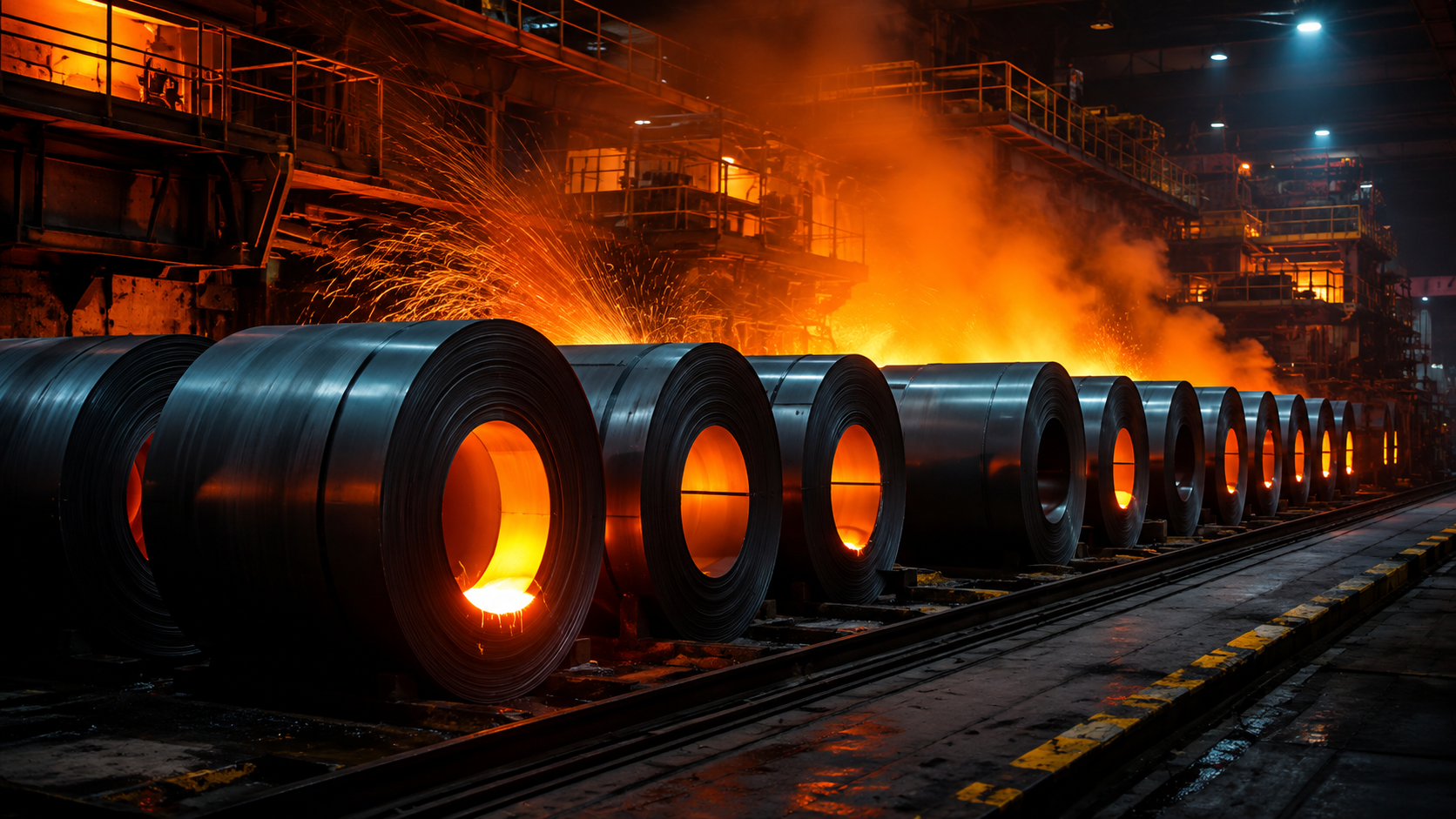
TL;DR: HR steel starts as molten steel cast into slabs, then reheated to 900°C–1,250°C before rolling. Primary rolling reduces slab thickness dramatically while increasing length and width. Finishing mills bring the steel to precise thickness, width, and surface consistency. Controlled cooling defines strength, hardness, toughness, ductility, and weldability. Final steel is cut or coiled, then inspected for dimensional and mechanical quality before dispatch.
A massive bridge stands strong over a busy highway. A factory structure stretches across acres of industrial land. Railway wagons move thousands of tonnes of cargo across the country. Heavy machinery works tirelessly in mines, warehouses, and manufacturing plants.
At first glance, these structures and machines seem unrelated. Yet behind many of them lies one common material: Hot Rolled (HR) Steel. But have you ever wondered how HR steel is manufactured how raw steel transforms into thick plates, sheets, coils, structural sections, and industrial components?
At Enlight Metals Private Limited, we believe understanding how steel is made helps industries choose the right material for the right application. Let's take a closer look at how hot rolled steel is manufactured.
Understanding Hot Rolled Steel
Hot Rolled Steel is processed at extremely high temperatures, generally above 900°C, which is higher than the steel's recrystallization temperature. At this temperature, steel becomes softer, more workable, and easier to shape into desired forms.
Unlike cold processing methods, hot rolling allows steel to be reshaped quickly and efficiently while maintaining strength and mechanical performance resulting in a highly versatile product used across construction, railways, automotive, engineering, fabrication, shipbuilding, pipelines, warehouses, and industrial manufacturing.
Step 1: Producing Steel Slabs The Starting Point
Every HR steel product starts with raw steel production. Iron ore, coal, limestone, and scrap steel are processed inside steel manufacturing plants to create molten steel, which is then poured into casting systems to produce semi-finished forms called steel slabs.
Slabs are giant rectangular blocks of steel that act as the starting material for hot rolled products thick, heavy, and extremely strong, but still far from becoming usable industrial steel. Before shaping can begin, they must first undergo heating.
Step 2: Reheating the Steel Slabs
Once slabs are ready, they're transferred to a reheating furnace, where temperatures typically range between 900°C and 1,250°C. Steel becomes softer and easier to shape at higher temperatures heating above the recrystallization point improves flexibility and allows manufacturers to reduce thickness without causing cracks or structural damage.
Inside the furnace, slabs are heated uniformly to ensure consistent mechanical properties across the entire steel section. This stage is critical uneven heating may affect dimensional accuracy and final product quality.
Step 3: Primary Rolling Reducing Thickness
After reheating, the hot slab enters a rolling mill, passing through massive industrial rollers that compress the steel under enormous force. With every pass through the rollers, thickness reduces while length and width increase this process is known as hot rolling.
The objective is simple: convert thick slabs into thinner, workable steel forms suitable for industrial applications. The rolling process also helps refine grain structure, improving the steel's mechanical consistency.
Step 4: Finishing Mills Precision Takes Over
After primary rolling, steel moves into finishing mills, where it's rolled multiple times to achieve specific thickness, width, and dimensional requirements. Depending on industrial demand, steel may be manufactured in different gauges and sizes for example, thinner HR coils for pipe manufacturing or thicker plates for heavy engineering and construction.
Finishing mills ensure the steel reaches the required dimensions while maintaining strength and uniformity, and also help improve surface consistency and overall product reliability.
Step 5: Controlled Cooling Defining Performance
Once rolling is complete, the steel is still extremely hot. The hot steel moves through cooling tables where water sprays and air-cooling systems gradually reduce temperature under controlled conditions.
Cooling directly affects the steel's mechanical properties, including:
- Strength
- Hardness
- Toughness
- Ductility
- Weldability
Step 6: Cutting or Coiling Creating the Final Product
After cooling, steel is converted into usable forms depending on application requirements cut into flat sheets or plates for fabrication, construction, heavy equipment, and industrial structures, or wound into coils for further processing. This stage transforms hot steel into commercially usable industrial material.
Step 7: Inspection and Quality Control
Before dispatch, HR steel undergoes rigorous inspection. Manufacturers check:
- Thickness accuracy
- Width consistency
- Surface condition
- Mechanical properties
- Dimensional tolerances
- Structural quality
Only steel meeting required standards proceeds for industrial distribution. At Enlight Metals Private Limited, we understand that consistent quality matters even small variations in steel performance can affect fabrication efficiency, structural integrity, and long-term reliability. That's why industries increasingly prefer dependable steel supply partners who prioritize quality assurance and timely availability.
The journey of hot rolled steel is a story of transformation from raw molten metal to one of the most dependable industrial materials in the world. Through heating, rolling, shaping, cooling, and precision inspection, steel becomes strong, versatile, and ready to support industries that build economies.