
Market & Price Trends
Key Factors Influencing Steel Prices in India: Understanding the Demand Side
22 Oct 2026
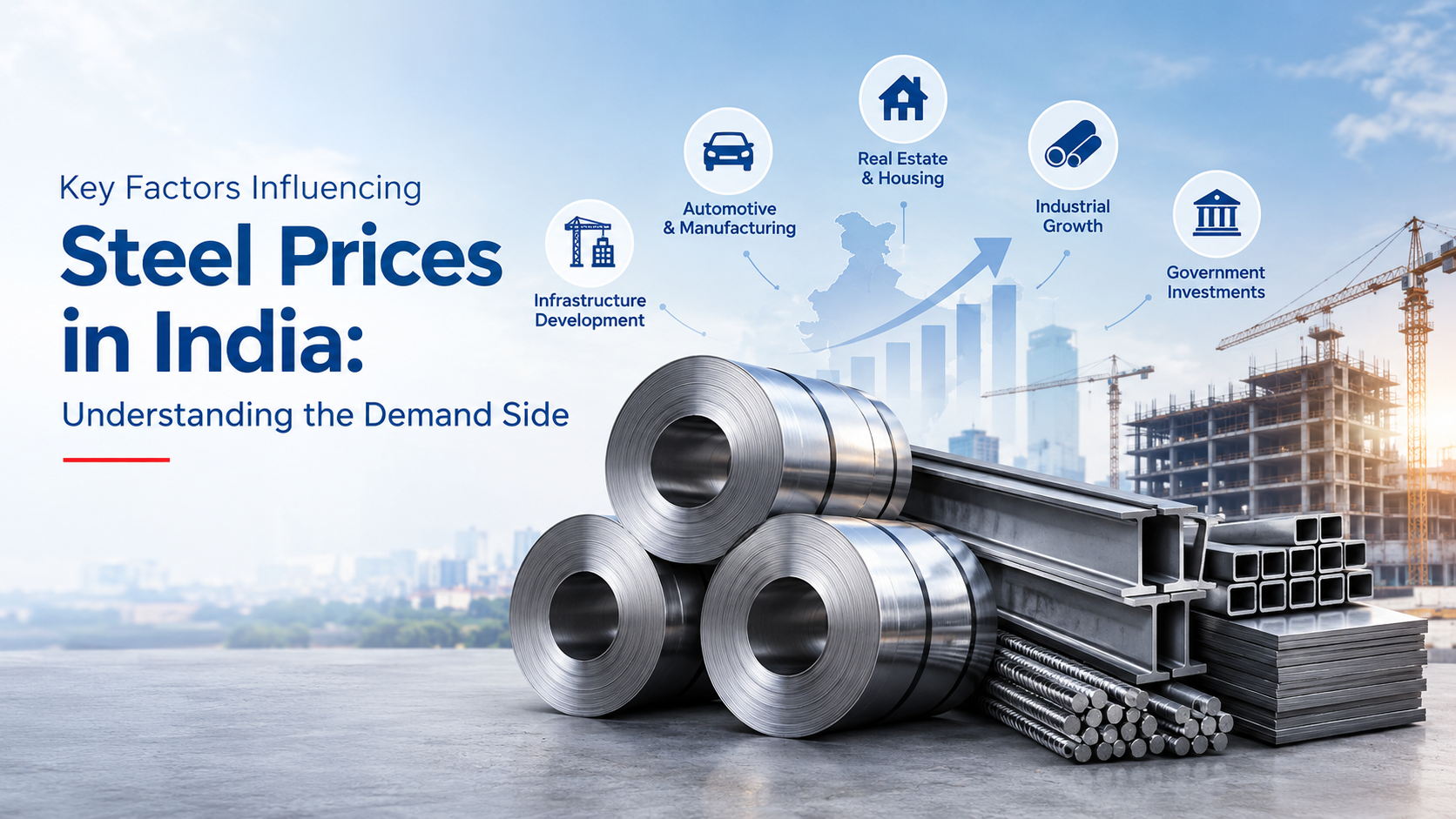
TL;DR: Steel prices in India depend on both supply-side and demand-side factors; this article focuses on demand. Infrastructure spending, construction activity and manufacturing growth are the biggest demand drivers. Seasonal cycles and buyer inventory behaviour can move short-term demand without any change in actual consumption. Exports and imports affect both domestic availability and price pressure. No single indicator explains every price movement, so buyers should track demand, supplier options and inventory together.
Introduction
Steel is a critical raw material for India's infrastructure, construction, manufacturing, automotive, and engineering sectors. As industrial activity expands and infrastructure investments continue, understanding the factors influencing steel prices in India becomes increasingly important for manufacturers, procurement teams, fabricators, and industrial buyers.
Steel prices are influenced by several interconnected factors, including raw material costs, production capacity, logistics, imports, exports, and overall market demand. While supply-side factors determine how much steel is available, demand-side factors help explain how much steel buyers require, when they purchase it, and how purchasing decisions change with market conditions.
For businesses involved in steel procurement, monitoring demand trends is essential for making informed purchasing decisions, planning inventory, and identifying sourcing opportunities.
At Enlight Metals, understanding industrial demand and customer requirements is an important part of supporting efficient steel sourcing and procurement. This article explores six major demand-side factors that influence steel prices in India and explains their implications for industrial buyers.
1. Infrastructure Spending and Government Projects
Infrastructure development is one of the major drivers of steel demand in India. Projects involving highways, railways, bridges, airports, metro networks, and industrial infrastructure require substantial quantities of steel at different stages of construction.
For example, highway development generates demand for reinforcing steel, structural components, and fabricated steel products. Railway infrastructure and bridge construction also require steel for structural applications, fabrication, and supporting infrastructure.
When infrastructure projects accelerate, steel demand may increase across several regions simultaneously. This can strengthen buying activity and influence steel prices, particularly when demand rises faster than available supply or distribution capacity.
However, the impact depends on project execution timelines, budget allocation, material procurement schedules, and the availability of steel products.
2. Construction and Real Estate Activity
Construction and real estate are significant steel-consuming segments. Residential buildings, commercial complexes, warehouses, industrial sheds, and large-scale development projects require different steel products depending on their structural and functional requirements.
For instance, residential construction creates demand for TMT bars, while industrial sheds and pre-engineered buildings require structural steel, plates, and other fabricated components. Warehousing expansion can also generate demand for structural sections, roofing systems, and steel-based infrastructure.
When construction activity increases, steel consumption generally benefits. Conversely, delays in project approvals, financing constraints, slower property sales, or postponed construction schedules can reduce immediate purchasing requirements.
The effect on steel prices in India also varies by product category. Strong demand for reinforcement steel does not necessarily translate into an equivalent increase in demand for HR coils, CR sheets, or galvanized products.
3. Manufacturing and Industrial Activity
Manufacturing growth is another important factor influencing steel prices in India. Industries such as automotive, capital equipment, engineering, electrical equipment, fabrication, and industrial machinery consume steel in different forms and grades.
For example, automotive component manufacturers may require cold-rolled steel (CR) for applications demanding specific surface quality and dimensional accuracy. Engineering and fabrication companies may use hot-rolled steel (HR), while galvanized steel (GP) is used in applications requiring corrosion protection and suitable surface characteristics.
When manufacturing output increases, steel consumption can rise across these product categories. Higher production schedules may lead manufacturers to increase procurement volumes, replenish inventories more frequently, or secure supply arrangements with preferred vendors.
However, demand varies according to the performance of individual industries. Growth in automotive production may strengthen demand for specific flat steel products, while expansion in industrial fabrication can create additional requirements for sheets, plates, and structural steel.
4. Seasonal Demand and Purchasing Cycles
Steel demand does not remain constant throughout the year. Weather conditions, construction schedules, financial cycles, and project execution timelines can influence purchasing activity.
The monsoon season, for example, may slow certain outdoor construction activities in some regions because of rainfall, site accessibility, and logistical challenges. This can temporarily affect steel dispatches and purchasing requirements.
However, the impact is not uniform across the country. Manufacturing operations, indoor fabrication, infrastructure projects, and industrial maintenance activities may continue despite seasonal disruptions.
Demand may also increase before planned project milestones or during periods when businesses accelerate procurement to meet production schedules. Consequently, seasonal demand patterns should be evaluated alongside regional and industry-specific conditions.
5. Buyer Inventory Behaviour and Procurement Decisions
Buyer behaviour plays an important role in short-term steel market movements. Steel-consuming businesses regularly evaluate prices, inventory levels, production requirements, delivery schedules, and expectations about future market conditions before placing orders.
When buyers expect steel prices to increase, some may advance purchases or build additional inventory. This can temporarily strengthen market demand, even if actual end-user consumption has not increased at the same rate.
In contrast, when buyers anticipate declining prices, they may postpone procurement and consume existing inventory before placing new orders. Such purchasing delays can reduce immediate buying activity and create downward pressure on market sentiment.
For example, a fabrication company expecting a major project order may increase its HR coil or structural steel inventory in advance. Another manufacturer facing uncertain demand may defer purchases until its confirmed production schedule becomes clearer. These decisions can influence order volumes, market enquiries, and short-term price movements.
6. Export Demand and Import Competition
India's steel market is connected to international trade. Export opportunities, imported steel availability, global demand conditions, and differences in international pricing can influence domestic market dynamics.
When export demand becomes attractive, domestic producers may allocate a greater share of production to export markets, depending on their commercial priorities and contractual commitments. This can affect the availability of particular products in the domestic market.
On the other hand, competitive imports can increase the options available to Indian buyers and place pressure on domestic prices in certain product categories. The actual effect depends on import duties, trade measures, freight costs, product specifications, delivery timelines, and exchange-rate movements.
Export and import trends therefore influence both the availability of steel and the purchasing decisions of domestic customers.
How Market Research Helps Businesses Understand Steel Price Movements
Understanding steel prices in India requires more than monitoring daily price quotations. Businesses also need to analyse the demand indicators that influence purchasing activity across industries and regions. Effective steel market analysis can include:
- Industry demand tracking: monitoring activity across construction, automotive, engineering, fabrication, and infrastructure
- Regional market mapping: identifying industrial clusters and locations with potential steel consumption
- Customer requirement analysis: understanding product grades, specifications, volumes, and purchasing frequency
- Procurement behaviour: evaluating order patterns, inventory requirements, and quotation conversion trends
- Market availability: assessing supplier options, delivery schedules, and product-specific sourcing conditions
These insights help businesses distinguish between temporary changes in buying activity and broader shifts in end-user demand. For industrial buyers, combining demand analysis with price monitoring, supplier evaluation, and inventory planning can support more informed procurement decisions.
How Enlight Metals Supports Industrial Steel Sourcing
Enlight Metals helps manufacturers, OEMs, fabricators, EPC companies, and industrial buyers source and procure steel through verified suppliers, competitive pricing, and coordinated delivery across India.
Understanding industry requirements is an important part of identifying suitable sourcing options. By considering product specifications, quantity requirements, supplier capabilities, and delivery locations, businesses can evaluate procurement options in line with their operational needs. Market intelligence also helps businesses identify potential demand centres, understand customer industries, and recognise emerging sourcing opportunities.
For industrial buyers, the objective is not simply to find the lowest quoted price. It is to evaluate the overall procurement requirement, including material suitability, availability, delivery coordination, and supplier reliability. Enlight Metals focuses on simplifying industrial metal sourcing by connecting procurement requirements with suitable supply options.
Conclusion
Steel prices in India are shaped by a combination of supply-side conditions and demand-side developments. Infrastructure spending, construction activity, manufacturing growth, seasonal purchasing cycles, buyer inventory behaviour, and international trade dynamics all contribute to changes in market demand.
The influence of each factor varies by steel product, region, industry, and time period. Therefore, no single indicator can fully explain every price movement. For manufacturers and industrial buyers, regularly monitoring steel demand, customer purchasing patterns, project activity, and regional market developments can improve procurement planning and business decisions.